Whitewool
About
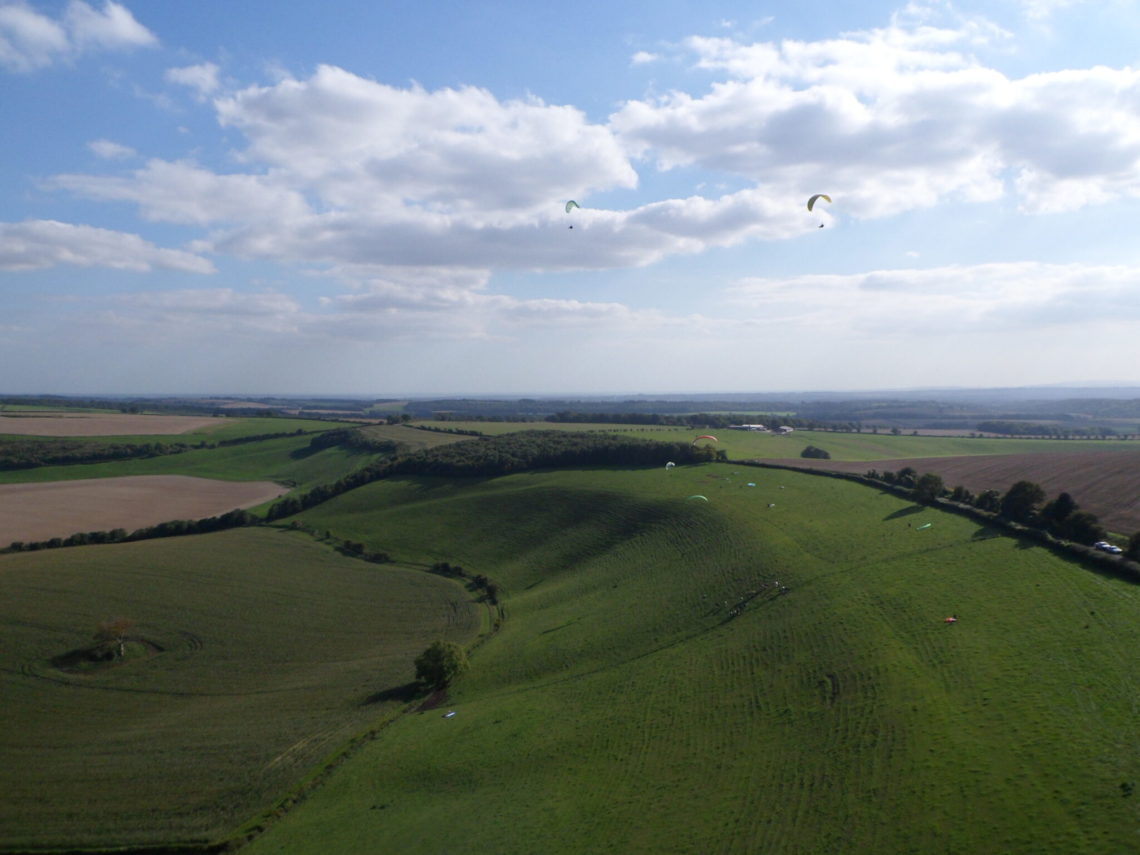
Whitewool is an east north east facing ridge with a small bowl at the southern end which can take a more north-easterly direction. It is a smooth slope clear of any obstructions with a shallower incline at the bottom making for comfortable slope landings.
Possible air ambulance landing location ///mondays.answer.evoke
Communication radio frequency 143.925
Aero-modellers are not permitted to use this site so the potential for conflict is avoided.
Access
Travelling north on the A3(M) from Portsmouth, take the slip road signposted for Clanfield. At the junction, turn left (west) along Chalton Lane. Continue for 1 mile, turn right past Rising Sun Pub on to East Meon Road. Follow the signs to East Meon. At approximately 3 miles, bear left then right at the junction along Droxford Road, following the signs to Warnford. Continue along past a left turn, a right fork and a crossroads. Three-quarters of a mile past the crossroads, the site is on the right.
Parking
New Parking Rules - our parking area has moved.
Please only park in the allocated area where you can park entirely off the road. This is approx 100m south of the main gates, where you can get all 4 wheels of your car entirely off the road.
There is space for approx 25-30 vehicles here, if parked considerately.
DO NOT PARK near the main gates please - it is only 100m walk to the new parking area.
Details
Location LAT/LNG | 50.9788 / -1.0755 |
Grid Reference | SU 650 204 SHEET: 187 |
What 3 Words | alert realm turned |
Wind Direction | 020 to 100 degreesWINDdirection |
Height | 190m (623ft) |
Top To Bottom | 60.96m (200ft) |
Nearest Phone | Clanfield village |
Site Contact | Whitewool Farm - Mr Jamie Butler 01730 823794 |
CP: Local Flights Only
The BHPA has clarified that Club Pilots (CP) must only make 'local' flights to remain insured by the BHPA 3rd party insurance. A local flight is one where the pilot remains within an easy glide of the official landing field. This will differ based on the conditions of the day. Club Pilots should take care to remain within an easy glide of the official landing field at each site.
Map
Site Rules
- This is strictly a members only site plus reciprocals. 20 pilots maximum on site.
- Please only park in the allocated area where you can park entirely off the road. Do not park in front of gates, or anywhere else along the lane. If there is no space in the marked car park please use the old winchester hill car park and approach the site on foot.
- Dogs are not allowed on site under any circumstances. Livestock will often be in the field.
- If it gets busy – other than coaches – move to Mercury / Chalton
- As always – if you are new to the site, please get a site briefing before flying.
- Do not climb over any fences.
Hazards
Expect turbulence downwind of the large tree at the bottom of the hill in all wind conditions. Severe turbulence has been experienced in thermic conditions.
This site looks harmless but it is not. There have been two serious accidents here in recent years.
Many pilots get caught out by top landing too close to the hedge at the back of the site, and then they get dragged into the hedge as they try to deflate their wing. A good rule of thumb when top landing this site is not to fly over the downwind half of the launch area. If you cannot get down without flying over the downwind half, then consider bottom landing instead.
If you do find yourself at risk of getting pinned while top landing, a little speedbar straight away is far better than going full bar later when you're very close to the ground.
Parakites
Parakites may fly at Whitewool, and Paraglider pilots should anticipate mixed flying with parakites on windier days. If you have concerns about mixed flying, calm communication is the best approach. Most parakite pilots on our sites are also paraglider pilots.
Takeoff
At any point along the slope
Landing
Bottom landings can be made in the area marked - only in the top half of the field and if NO CATTLE ARE IN EITHER OF THOSE TWO LONG THIN FIELDS. Please slope land if at all possible and stay within the bounds of the main site field.
Top landing can be made anywhere within the boundary of the site. BEWARE - many pilots have been caught out when top landing by flying too far downwind, and then touching down too close to the hedge at the back of the top landing area. Then they get dragged and end up with their wing in the hedge or even draped accross the hedge and into the road. Don't let this happen to you. A good rule of thumb when top landing is not to fly over the downwind half of the launch area. If you find you cannot lose altitude without going over the downwind half, it may be too windy - consider bottom landing instead.
Slope landing can be made anywhere within the boundary of the site.
Consider
This is the most sensitive site we have, it is in full view of the owners and any breach of the rules will cause it to be lost to us. The farmer will claim for any damage.
The reverse (western) side of this ridge is owned by English Nature, it is a nature reserve that has banned all forms of recreational flying therefore only contemplate cross country flights if the fields behind launch can be cleared.
Car break-in/theft is very common in the area.
Cross Counry
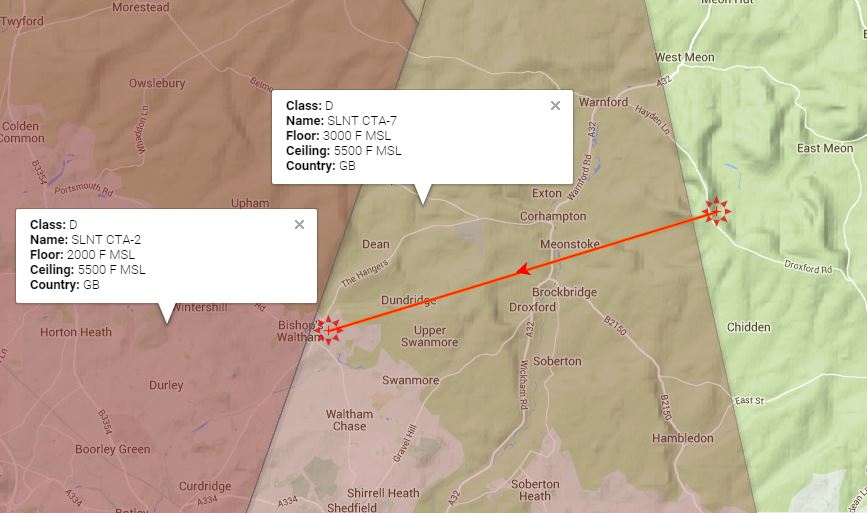
One good climb will take you into Southampton airspace at 3000ft so you have to have a GPS to stay safe here and set the airspace alarm!
Leaving the Hill
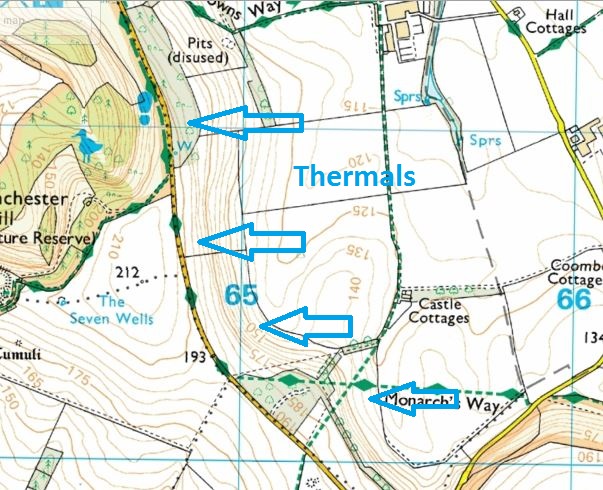
There are thermals all over the place and there are reliable house thermals bang in the middle of the ridge as well as at both ends.
If you are over the trees to the north of the hill, beware of the deep gully behind you and the higher venturi that can form here.
First XCs
Whitewool is very limited in terms of distance, but to practice breaking the psychological tie to the hill (and your car), it is perfect.
Take the first climb till your proximity alarm goes off, then head off downwind under the airspace. The flight shown alongside is 10km and you will need a second climb of some sort to reach Bishop’s Waltham.
For the more adventurous
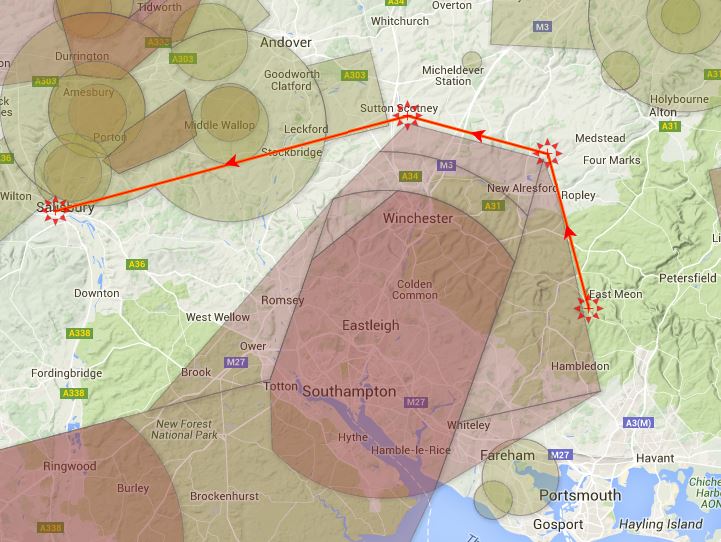
There are a number of un-tapped possibilities from Whitewool and Mercury. One is triangles, which have been done with some success; the other is to clear Southampton airspace.
If you can time it right and be flying as the wind shift slightly more to the south, you should be able to cross wind to the north and clear airspace. Before this airspace was here, hang-gliders made it to Wales from nearby Mercury!